What Is Precast Concrete?
Precast concrete is concrete that’s cast off-site, in a controlled manufacturing facility, then transported to your project and erected by crane. That’s the short answer. Understanding what it means for your schedule, your budget, and the long-term performance of your structure is where precast’s real value becomes clear.
How It’s Made
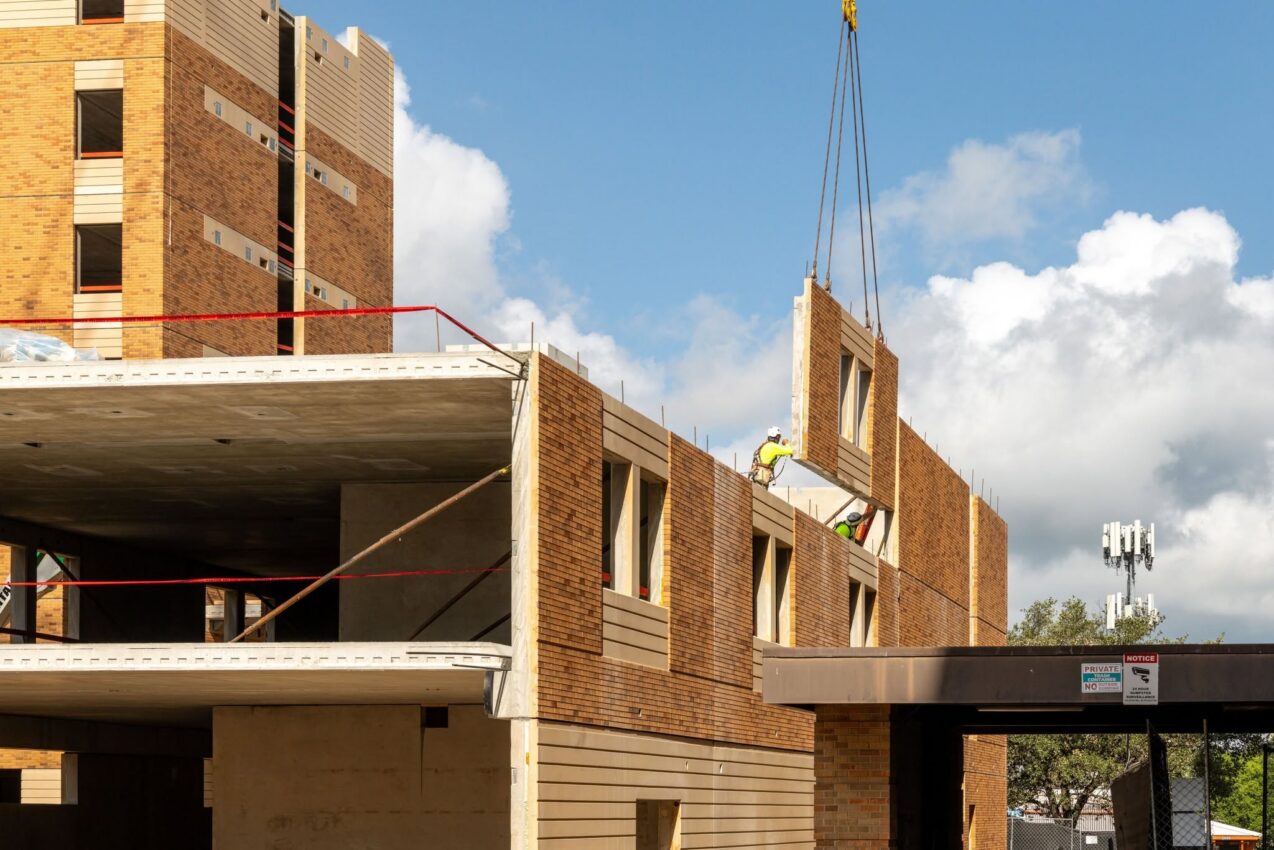
Unlike site-cast concrete, precast components are produced in a factory environment using steel or wooden forms. Once the forms are complete, the precast process follows four steps:
- Casting: Concrete is poured into precision forms at one of Tindall’s six manufacturing facilities.
- Curing: Components cure under controlled temperature and humidity conditions. No weather delays, no site variables.
- Quality inspection: Every piece is inspected to make sure it meets stringent quality standards before it leaves the plant.
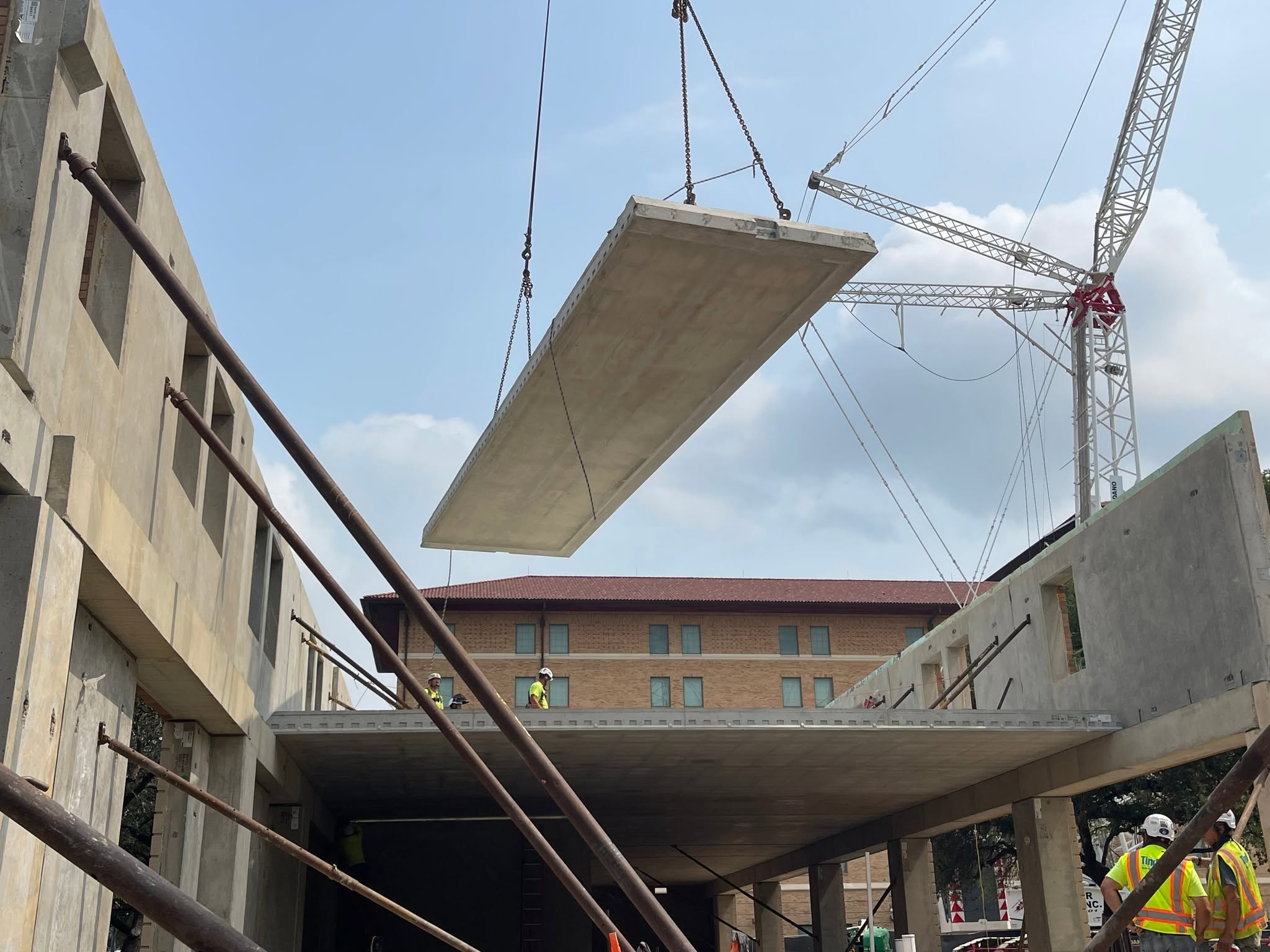
- Delivery and assembly: Components ship to your site, where they are lifted by crane and placed according to an engineered sequence.
Because manufacturing and site preparation happen at the same time, precast concrete keeps your project moving faster than cast-in-place construction would allow.
The Role of Prestressing
Prestressed concrete is a type of precast that incorporates high-strength steel strands in addition to conventional reinforcing. Those strands are pulled to approximately 40,000 pounds of tension per strand before the concrete is poured. Once the concrete reaches adequate strength, the strands are cut. The tension in the steel is transferred to the concrete as compression, strengthening the component.
The result:
- Longer spans with shallower depths
- Greater load capacity without adding mass
- Improved performance under sustained and dynamic loads
- Better resistance to cracking and deflection over time
Most structural precast used in buildings and infrastructure is prestressed. At Tindall, it’s the foundation of nearly everything we design and manufacture.
3 Ways PCI Classifies Precast
- Structural Precast Concrete Load-bearing components that form the skeleton of a building or structure. Common examples include:
- Double tees and flat slabs
- Beams, girders, and inverted tee beams
- Columns, spandrels, and wall panels
- Arch culvert tunnels and bridges
- Architectural Precast Concrete Panels and components held to a higher standard of appearance, covering color, surface detail, and texture uniformity. Common examples include:
- Wall panels and column covers
- Cornice, sills, and window surrounds
- Decorative trim and site elements
- Prestressed Concrete Both structural and architectural components can be prestressed through two primary methods:
- Pre-tensioning
Strands are tensioned before concrete is placed and released once the concrete reaches adequate strength. The most common method in precast plants. - Post-tensioning
Strands are tensioned after the concrete reaches strength, with force transferring through endplates rather than bond. Used in specific applications where pre-tensioning isn’t practical.
- Pre-tensioning
What Is Precast Concrete Used For?
Precast can be used on almost any structure, but it performs best where footprints are large, layouts are repetitive, and schedules are tight. Here’s where it’s most commonly specified:
Building Types
- Parking structures
- Correctional facilities and justice centers
- Multifamily and mixed-use residential
- Data centers and industrial facilities
- Healthcare campuses and medical office buildings
- Education, dormitories, and institutional buildings
- Manufacturing
- Warehouse
Infrastructure Applications
- Arch culvert tunnels and bridges
- Power and energy structures
- Petrochemical
- Utility products
The economics improve as the building grows. In a multi-story structure, one column may support several floors, and fewer total crane picks per square foot means real savings on both cost and schedule.
Why Do Builders Choose Precast Concrete?
The advantages show up across every phase of a project, from the day manufacturing starts to the decades after the structure is complete.
Schedule
- Manufacturing begins before the foundation is complete.
- Components arrive ready for installation, no on-site curing, shoring, or scaffolding required.
- Faster erection means earlier access for mechanical, electrical, and other trades.
- Precast construction is less dependent on weather conditions than site-cast alternatives.
Structural Performance
- Prestressing enables longer spans at shallower depths than cast-in-place.
- Precast is non-combustible, with fire ratings achievable up to four-hour endurance.
- Precast systems can be designed to perform under special conditions, such as wind, seismic, and progressive collapse.
- Precast walls and floors deliver excellent sound transmission class (STC) without added treatments.
Building Envelope
- Insulated wall panels achieve high R-values with insulation built into the panel, no separate trades required.
- High thermal mass reduces heating and cooling loads.
- Load-bearing wall panels can also serve as shear walls, eliminating redundant perimeter framing.
Site Safety and Efficiency
- Fewer workers are needed on site during erection.
- No shoring or scaffolding is required.
- Precast construction reduces waste and debris on the jobsite.
- A shorter overall construction duration reduces site exposure.
Sustainability
- Precast components are manufactured using materials that are regionally sourced, low-emitting, and may contain recycled elements.
- Factory production reduces on-site waste.
- Durability lowers lifecycle maintenance costs and replacement frequency.
- Typical life cycle spans of 50-100 years.
- Precast components are LEED-credit eligible.
Design Flexibility
- Typical spans range from 30-60 feet for double T members. Bulb T members can achieve spans over 100 feet.
- Finish options include pigments, aggregates, sandblast, brick, terra cotta tile, formliner, and custom forming.
- MEP blockouts and cast-in conduits can be incorporated during manufacturing when the precaster is engaged early.
How Does Precast Compare to Cast-in-Place Concrete?
| Precast | Cast-in-Place | |
|---|---|---|
| Where it Cures | Off-site, controlled facility | On-site, exposed to weather |
| Schedule | Parallel manufacturing and site work | Sequential: forms, pour, cure, strip |
| Quality Control | Factory inspected before delivery | Variable, dependent on site conditions |
| Site Labor | Reduced, crane installation crew | Larger forming and finishing crews |
| Scaffolding/Shoring | Not required | Typically required |
| Finish Options | Extensive (color, texture, profile) | Limited |
| Span Capability | Extended by prestressing | Dependent on reinforcement and depth |
For large, repetitive structures, precast typically outperforms cast-in-place on both installed cost and schedule. The advantage grows as building size increases.
What To Know Before You Specify Precast
A few questions come up consistently when project teams are evaluating precast for the first time, or returning to it after working with other systems. Most have straightforward answers. All of them shape how the system gets specified.
Fire resistance is built in, not added on. Precast concrete is non-combustible. Components can be designed to meet two-, three-, or four-hour fire ratings based on concrete cover and aggregate type, all in accordance with ASTM E-119. You don’t need a separate fire protection system layered onto the structure.
The envelope and the structure can be the same thing. Insulated precast wall panels can be designed to carry floor and roof loads, resist lateral forces, and deliver high R-values, all in one component. That eliminates redundant perimeter framing and keeps insulation installation off the subcontractor coordination list.
MEP coordination can happen at the plant, not in the field. When Tindall is engaged during design, conduit runs, electrical boxes, blockouts, and drain penetrations can be cast directly into structural members. Field drilling and cutting after erection costs more and takes longer.
Sound performance doesn’t require added treatment. Concrete mass is one of precast’s inherent advantages for STC performance. Precast walls and floors typically meet sound insulation requirements without additional layers or assemblies.
Precast contributes directly to LEED. Recycled content, regional material sourcing, reduced construction waste, and the thermal performance of insulated panels all support LEED credit pursuit. If certification is a project goal, it’s worth discussing early.
The earlier you engage, the more the system can do. Span optimization, column spacing, panel sizing, connection details, decisions made in design development shape what precast can deliver on schedule and cost. Late engagement narrows those options.
When Should You Bring a Precast Partner Into Your Project?
Early. The sooner the Tindall team gets involved, the more value we can provide.
- Design phase: We can help optimize the structural system for precast efficiency, covering span lengths, column spacing, and panel sizes.
- Pre-construction: We can provide schedule input, accommodate MEP requirements, and develop connection details that reduce field labor.
- Procurement: Lead times for precast manufacturing need to be planned ahead. Late engagement compresses the schedule and limits options.
If you’re evaluating precast for a project that’s already in design development, it’s not too late. But the sooner, the better.
Every structure Tindall builds starts with a discussion about what the project actually needs. Ready to start that conversation?